The Retirement Tax Stack
Income pieces can connect
Key Takeaways
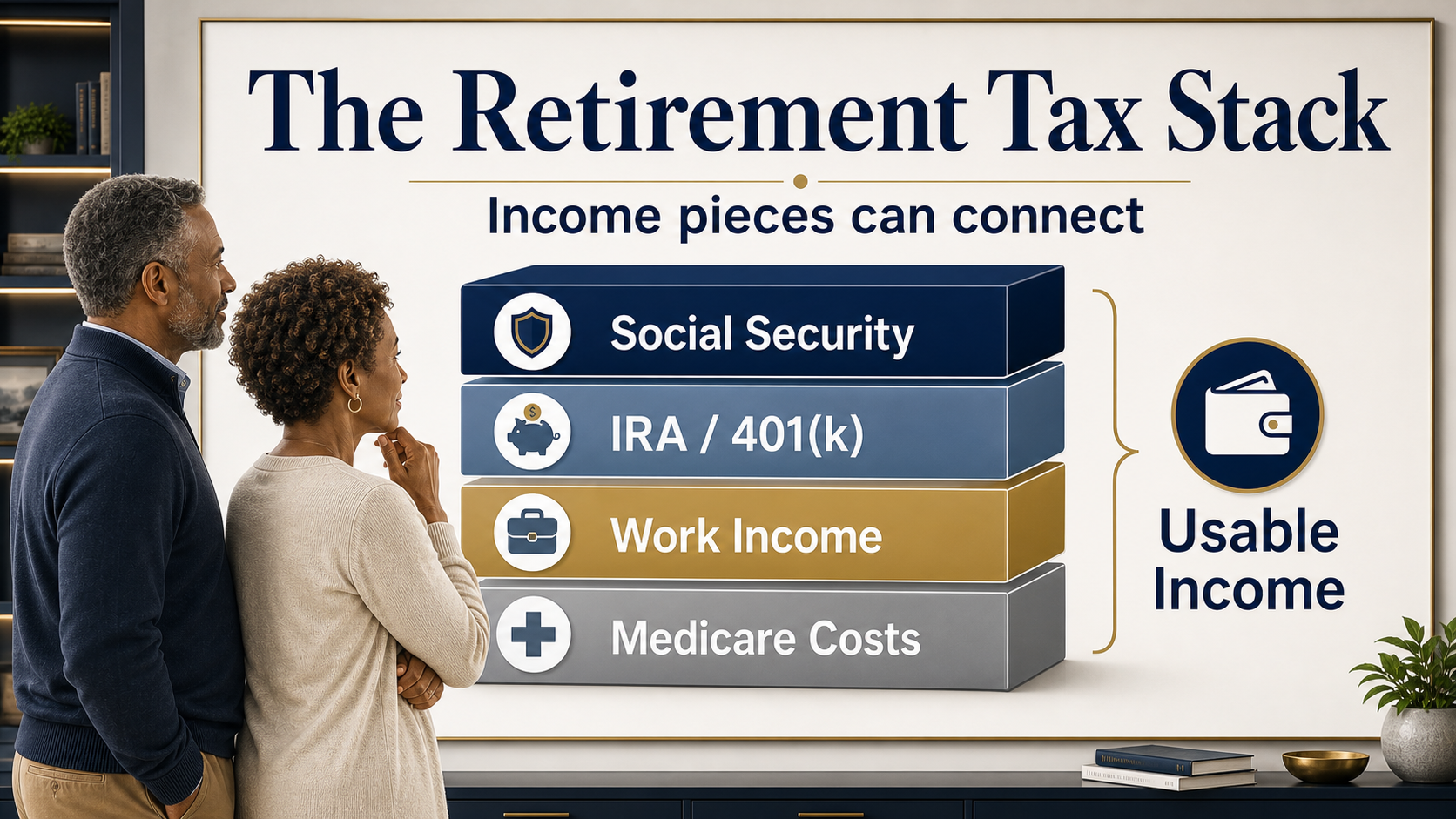
- Retirement taxes may not show up as one bill. They can appear through several connected income pieces.
- Social Security, IRA or 401(k) withdrawals, work income, and Medicare-related costs can interact.
- Gross income is not the same as usable income after taxes and costs.
- Tax questions should be reviewed with qualified tax professionals.
What does this actually mean?
Taxes in retirement can be confusing because they do not always show up as one bill. They show up in pieces.
Social Security may be one piece. Withdrawals from an IRA or 401(k) may be another. Part-time work may be another. Medicare premiums may be another.
Why the stack matters
Each piece can seem separate. But in real life, they can connect. Income from one source may affect taxes on another source.
Income may also affect Medicare-related costs for higher-income households. That does not mean people should be afraid. It means people should understand the basic map.
Where does Aftura fit?
RetireIQ helps organize the questions. It does not provide tax advice, calculate tax liability, or recommend a withdrawal strategy.
Why do taxes feel different in retirement?
During working years, taxes may feel tied to a paycheck. In retirement, income may come from several places, and each place may have different rules.
That is why retirees can be surprised. They may think about income one piece at a time, while the tax system may look at the pieces together.
How can Social Security and withdrawals interact?
For some households, Social Security benefits may be taxable. Withdrawals from retirement accounts may affect that calculation.
This does not mean a person should avoid withdrawals. It means the order, timing, and source of income may deserve review with a tax professional.
Can Medicare costs be part of the tax stack?
Higher income can affect certain Medicare-related costs for some households. That can make usable income different from gross income.
A retirement income decision can therefore have more than one effect. It may affect taxes, cash flow, and healthcare-related costs.
What is the simple lesson?
The goal is not to turn every retiree into a tax expert. The goal is to know that retirement income pieces can connect.
Once that is clear, a household can ask better questions before making large income decisions.
What mistakes should readers avoid?
The first mistake is treating one visible number as the whole answer. In retirement, the visible number may be an age, a savings balance, a withdrawal rule, a premium, or a tax estimate. The visible number matters, but it is rarely the whole story.
The second mistake is assuming that one household's answer should become another household's answer. Two families can look similar from the outside and still have very different income needs, health costs, tax situations, family goals, and comfort levels.
The third mistake is waiting until the decision feels urgent. Retirement questions are easier to understand when they are reviewed before a deadline.
How should readers think about tradeoffs?
Most retirement decisions involve tradeoffs. More flexibility may mean less certainty. More certainty may involve costs or limits. More income today may affect income later. More protection may reduce access to money in some situations.
This is why the goal is not to find a perfect answer from one article. The goal is to understand the moving parts well enough to have a better next conversation.
A clear tradeoff is not a problem. It is useful information. It helps a household see what it may be giving up and what it may be getting in return.
Why can averages mislead people?
Averages can help people learn, but averages can hide personal details. Average returns, average inflation, average healthcare costs, and average retirement ages may not describe a specific household.
Averages are most useful when they start a question. They become risky when they end the question.
A better approach is to use averages as a doorway, then review the personal facts that could change the result.
How does this connect to RetireIQ?
RetireIQ is designed to organize the questions behind the article. It does not replace a professional review, and it does not tell a visitor what financial product to buy.
Its job is diagnostic. It helps make income pressure, inflation pressure, timing questions, and planning gaps easier to see.
That kind of diagnosis can make a future conversation more useful because the visitor is no longer starting from a blank page.
Selected references
- IRS: Social Security benefit taxation education.
- Medicare.gov: income-related monthly adjustment amount education.